


What Is Benefit-in-Kind (BIK) in Ireland? A Plain-English Guide for Employers
Benefit-in-kind (BIK) in Ireland is any non-cash benefit of monetary value an employer gives an employee, such as a company car, employer-paid health insurance or a voucher. Revenue treats it as taxable pay, so Income Tax, PRSI and USC are deducted through PAYE on its value unless a specific exemption applies.

What counts as benefit-in-kind in Ireland
Revenue defines a benefit-in-kind as a non-cash benefit of monetary value that you provide for an employee. Payroll teams call it notional pay. Everyone else calls it a perk. Whatever the label, it has a value, and that value is taxable income.
The list is broader than most employers expect. A company car available for private use is a BIK. So is a van, employer-paid medical insurance, a preferential loan, employer-provided accommodation, a gym membership put on the company card, and the voucher handed out at Christmas.
Two rules catch people out. The first is a small income floor: if an employee's total income including benefits comes to more than €1,905 in a tax year, their benefits are taxable. Income from a previous job is left out of that calculation, but income from several businesses under the same parent company is added together. The second rule removes the floor entirely for directors. A company director pays tax on any benefit-in-kind regardless of what they earn.
Some things people assume are benefits are not. Reimbursing a genuine business expense is not a benefit. Neither is a canteen meal available to all staff on the same terms, or equipment provided for the job. The test Revenue applies is whether the employee has received something of monetary value for their private use, not whether the company paid for it.
Passing the benefit to someone else does not move the tax. If you provide a benefit to an employee's spouse, civil partner, family member, dependant or guest, the employee is the one taxed on it.
BIK and the Small Benefit Exemption are not the same thing
This is the distinction that costs Irish employers the most money, and it usually starts with someone assuming a gift card is automatically tax-free.
It is not. A voucher is a benefit-in-kind by default. Revenue says so plainly: the face value of a voucher is generally the value of the benefit, and that value goes through payroll as notional pay unless an exemption applies.
The Small Benefit Exemption is that exemption. Since 1 January 2025 you can give an employee up to five small benefits a year tax-free, provided the combined value stays at or below €1,500 and none of them is cash. Budget 2026 left both numbers alone, so the same limits apply for the 2026 tax year.
The gap between the two treatments is wide. An employee on the higher marginal rate loses just over half of a taxable benefit to Income Tax, USC and PRSI, so a €1,500 taxable voucher arrives worth roughly €715 in their hand, while the employer has paid full price and an employer PRSI charge on top. Run the same €1,500 through the exemption and the employee keeps all of it. Your payroll provider can confirm the exact marginal rate for a given employee.
A worked example makes the shape of it clear. Say you want to give twenty staff €500 each at Christmas. Handled as one benefit under the Small Benefit Exemption, that is €10,000 out the door and €500 landing with each person. Handled as a taxable voucher, the same €10,000 of value costs the business about €11,125 once employer PRSI is added, each employee sees roughly €239 after deductions, and payroll now has twenty notional pay entries to process. More cost, less than half the effect, and more admin.
How BIK is valued, reported and paid
Valuation depends on what you gave. The common cases:
Once you have the value, the mechanics are ordinary payroll. Add it to the employee's pay as notional pay and deduct Income Tax, PRSI and USC through PAYE for the period in which the benefit was provided. Revenue allows the tax on some benefits to be spread across the year rather than landing in a single payslip, which matters when a large BIK would otherwise wipe out a month's net pay.
Exempt benefits still need reporting. Under Enhanced Reporting Requirements you must tell Revenue the date and value of each Small Benefit Exemption benefit on or before the date you provide it. Filing after the fact is a common and avoidable error.
Timing is the part payroll teams raise most often. A benefit provided in December has to be reported and taxed in the December pay period, not tidied up in January, and that catches out companies who order gift cards late and distribute them in the first week of the new year. Order early enough that the delivery date, the payroll period and the ERR filing all sit in the tax year you intended.
Where employers get benefit-in-kind wrong
- Assuming a gift card is tax-free: it is tax-free only if it meets the exemption conditions. Fail one of them and the full face value goes through payroll.
- Handing out a sixth benefit: only the first five benefits in a year can qualify. The sixth is taxable even if you are nowhere near €1,500.
- Going over on a single benefit: a single benefit of €1,501 is not taxed on the €1 above the limit. The entire €1,501 becomes taxable.
- Choosing something convertible to cash: the benefit has to be usable only to buy goods or services. If it can be redeemed in whole or in part for cash, the exemption is gone.
- Banking the leftovers: unused allowance does not roll forward. Give €800 in 2026 and you start 2027 back at €1,500, not €2,300.
- Reporting late: ERR filings are due on or before the date the benefit is provided, not at year end.
One more is less about tax than about arithmetic. If you decide to pay an employee's BIK liability on their behalf, that payment is itself a benefit and carries its own charge. Talk to your accountant before offering it.
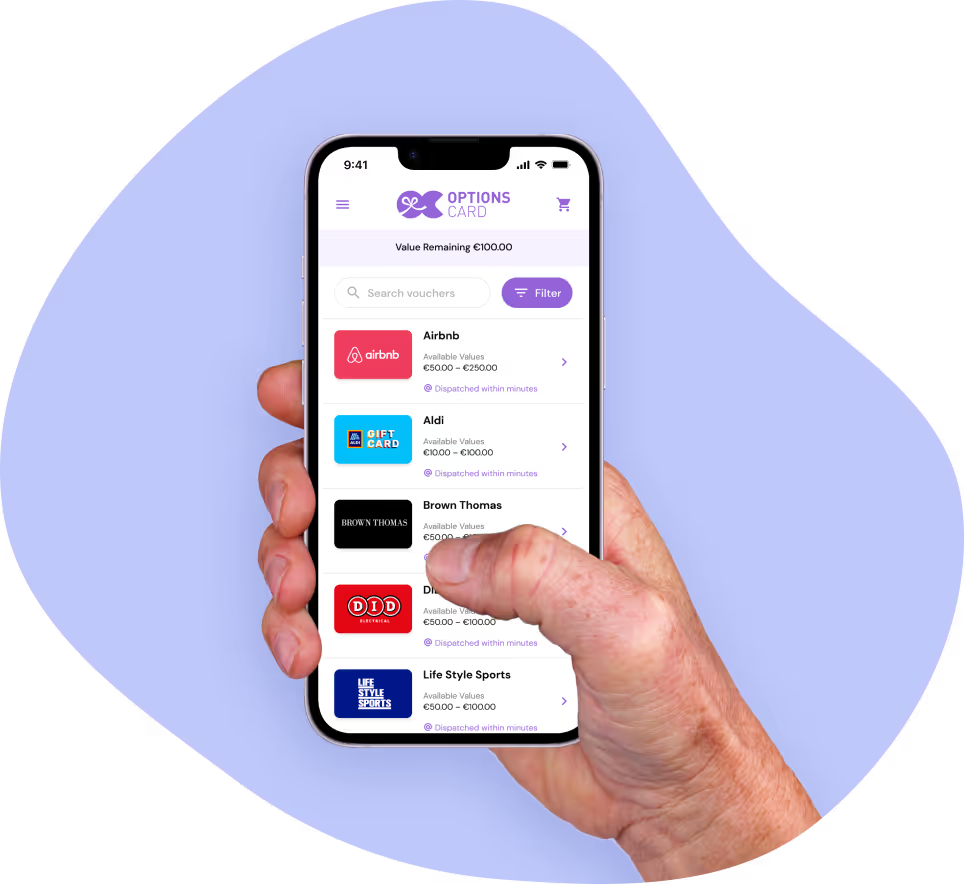
OptionsCard was built around these rules. It is a digital gift card the recipient redeems for retailer gift cards from a catalogue of over 70 Irish and international brands, so the value goes to goods and services rather than cash. It carries no fees, it is valid for five years, and businesses can order up to €25,000 online by invoice. Employers using it under the Small Benefit Exemption still need to file the ERR return for each benefit.
Ready to use the Small Benefit Exemption without creating a payroll problem? Sign up at app.optionscard.ie/register and order what you need online. If you would rather talk through bulk ordering or year-end timing first, email us at sales@optionscard.ie.
*Details correct as at August 2026, confirm with your accountant.
Frequently asked questions


Want to gift your employees?
Buy up to €25,000 of OptionsCards online now when paying by invoice.
For larger or corporate gift card customers give us a call or contact our sales team.